


 It has been quite a while since I have last posted about my kantele builds and endeavors. I finished kantele #004 last year towards the end of last summer, but instrument building has been on hiatus due to switching gears for crafting numerous birthday and Christmas presents for the past several months from September to December, and has been a very busy schedule. This newest kantele I must say though is my absolute favorite one to date, and was definitely a challenging but rewarding build.
 Kantele #004 features probably the most exotic wood selection of my kanteles yet. The frame is made from bubinga, an extremely heavy and hard wood with excellent tonal qualities. The sides also feature a soft maple strip at the bottom for a bit of contrast. The backboard and headplate are made from wenge, another very hard and dense wood. It can be a bit tough to work with due to its hardness, but can carve quite nicely if done slowly and carefully, and takes an excellent polish. The soundboard is the same as the first three kantele, using 1/8" cypress. This piece of cypress was the most uniform and straightest grain of all the pieces I got, and specifically saved it for this instrument.

 Luckily during my build of Kantele #002, I had exactly enough wood to make another 8 string kantele. So I did, and made Kantele #003 a twin of the previous. It has a different theme, but made of the same exact woods with the same exact dimensions. Interestingly enough, the sound is very different. I will do a comparison of these two in a future post. I will say however, that I really like the tone of #003, and feel that it is a significant improvement, much more mellow and rich.

 Though the woods are the same, there is definitely a noticeable difference in style. This kantele uses kind of a "curl" theme, reflected in the ponsi, headboard, and "f-hole" soundhole. The dragon flairs on this ponsi was particularly fun and challenging to carve, being my first attempt at such type of carving. Despite having an unusual grain, I found the leopardwood very nice to carve and hold its shape, but one must work with the grain flow to avoid chipping or tearing of the wood. Another unique feature of the ponsi is the carved top and front profile. This was inspired by the geometric chip carving style, and was also a first for me as well. The inside curve where the varras, or string-holding bar is located, is also a noticeable improvement from the previous two, which has a very round vertical profile as opposed to the more flat-sawn curve shape of its predecessors. The decorative headplate is simpler than #002, and cleaner all around than the previous. I had bought another padauk rosette to inlay, but felt that the added wood to accommodate it would make the headplate unnecessarily bulky. There is also less overlap onto the vibrating portion of the soundboard, possibly contributing to its overall better tone. #003 turned out only slightly wider in size, but all other dimensions remained the same. I do feel that the cypress used for this soundboard was also a bit nicer quality than #002.

 I also chose a much nicer curly hard maple board to use for the backboard, which has much more noticeable and attractive figure than #002. Curly hard maple takes a beautiful polish, and with the curl can provide quite a stunning look. The soundhole was quite a bit more challenging: since I already glued the backboard on before cutting it out (to ensure it went on straight, since it can slightly move around during the gluing process), I had to drill many tiny holes along the outline of the shape, then slowly cut away the shape with a very sharp knife and chisel by connecting the dots. The larger soundhole also not only lends itself nicely to the overall theme, but provides more volume while still keeping the aesthetics of a backboard.
 .JPG "kantele #002") I have learned a tremendous amount from the kanteles that I have built, and continue to learn with each one. My second kantele, #002, was started around the same time as my first, and finished shortly after (you can click on the thumbnail images for a larger more detailed view). Like my first kantele, I used leftover wood from previous projects for the frame of the instrument. Having already built a 5 string model, I wanted to play around with a slightly larger stringed instrument. Having only one string size though and a limited budget, I opted to build a small 8 string model. This kantele is also 24" long, a bit wider at 5.75" wide, and tuned to the diatonic scale in the key of C. I wanted to add some contrast in the sides, so the frame consisted of mahogany with a thin strip of soft maple accent at the top, which would be mirrored on the bottom by a curly hard maple backboard. Not having enough mahogany for the tuning peg shelf, I bought a turning blank made of African mahogany to use.
I have learned a tremendous amount from the kanteles that I have built, and continue to learn with each one. My second kantele, #002, was started around the same time as my first, and finished shortly after (you can click on the thumbnail images for a larger more detailed view). Like my first kantele, I used leftover wood from previous projects for the frame of the instrument. Having already built a 5 string model, I wanted to play around with a slightly larger stringed instrument. Having only one string size though and a limited budget, I opted to build a small 8 string model. This kantele is also 24" long, a bit wider at 5.75" wide, and tuned to the diatonic scale in the key of C. I wanted to add some contrast in the sides, so the frame consisted of mahogany with a thin strip of soft maple accent at the top, which would be mirrored on the bottom by a curly hard maple backboard. Not having enough mahogany for the tuning peg shelf, I bought a turning blank made of African mahogany to use.
.JPG "kantele #002 african mahogany tuning peg shelf") As a side note, I got this turning blank from Westpenn Hardwoods, an absolutely awesome source of exotic turning blanks. This place is also on my top wood supplier list. Their selection is incredible, and is a great source for exotic woods for the frame, as well as bowl turning blanks for exotic wood ponsis. For their turning blanks to be used as woods for the sides, I normally buy 24" long to 36" long 1.5"x1.5" turning blanks, and rip them in half length-wise for a matching set of .75" thick x 1.5" wide pieces. Future kanteles I will be building with woods from them including cocobolo, bocote, bubinga (now complete) and east indian rosewood. A very economical method for getting beautiful exotic hardwoods for kantele making for only a fraction of the price you would spend ordering one custom built from a luthier. I will post more details and info on exotic wood selection and simple shortcuts to beautiful and affordable woods in posts to come.
As a side note, I got this turning blank from Westpenn Hardwoods, an absolutely awesome source of exotic turning blanks. This place is also on my top wood supplier list. Their selection is incredible, and is a great source for exotic woods for the frame, as well as bowl turning blanks for exotic wood ponsis. For their turning blanks to be used as woods for the sides, I normally buy 24" long to 36" long 1.5"x1.5" turning blanks, and rip them in half length-wise for a matching set of .75" thick x 1.5" wide pieces. Future kanteles I will be building with woods from them including cocobolo, bocote, bubinga (now complete) and east indian rosewood. A very economical method for getting beautiful exotic hardwoods for kantele making for only a fraction of the price you would spend ordering one custom built from a luthier. I will post more details and info on exotic wood selection and simple shortcuts to beautiful and affordable woods in posts to come.
.JPG "kantele #002 decorative headplate") I chose to stick with cypress for the soundboard, as I had excellent results with Kantele #001, and did not want to vary too much yet with soundboards. The ponsi uses leopardwood, a beautiful exotic hardwood that finishes excellently. I also used a thin strip of padauk on the bottom of the ponsi as well. The decorative headplate also uses leopardwood, with another inlaid rosette from Folkcraft Instruments. I opted for the soundhole to be located on the backboard again, this time using a larger diameter of about 2.5". Stay tuned for sound clips and playing description of this kantele in upcoming posts!
I chose to stick with cypress for the soundboard, as I had excellent results with Kantele #001, and did not want to vary too much yet with soundboards. The ponsi uses leopardwood, a beautiful exotic hardwood that finishes excellently. I also used a thin strip of padauk on the bottom of the ponsi as well. The decorative headplate also uses leopardwood, with another inlaid rosette from Folkcraft Instruments. I opted for the soundhole to be located on the backboard again, this time using a larger diameter of about 2.5". Stay tuned for sound clips and playing description of this kantele in upcoming posts!

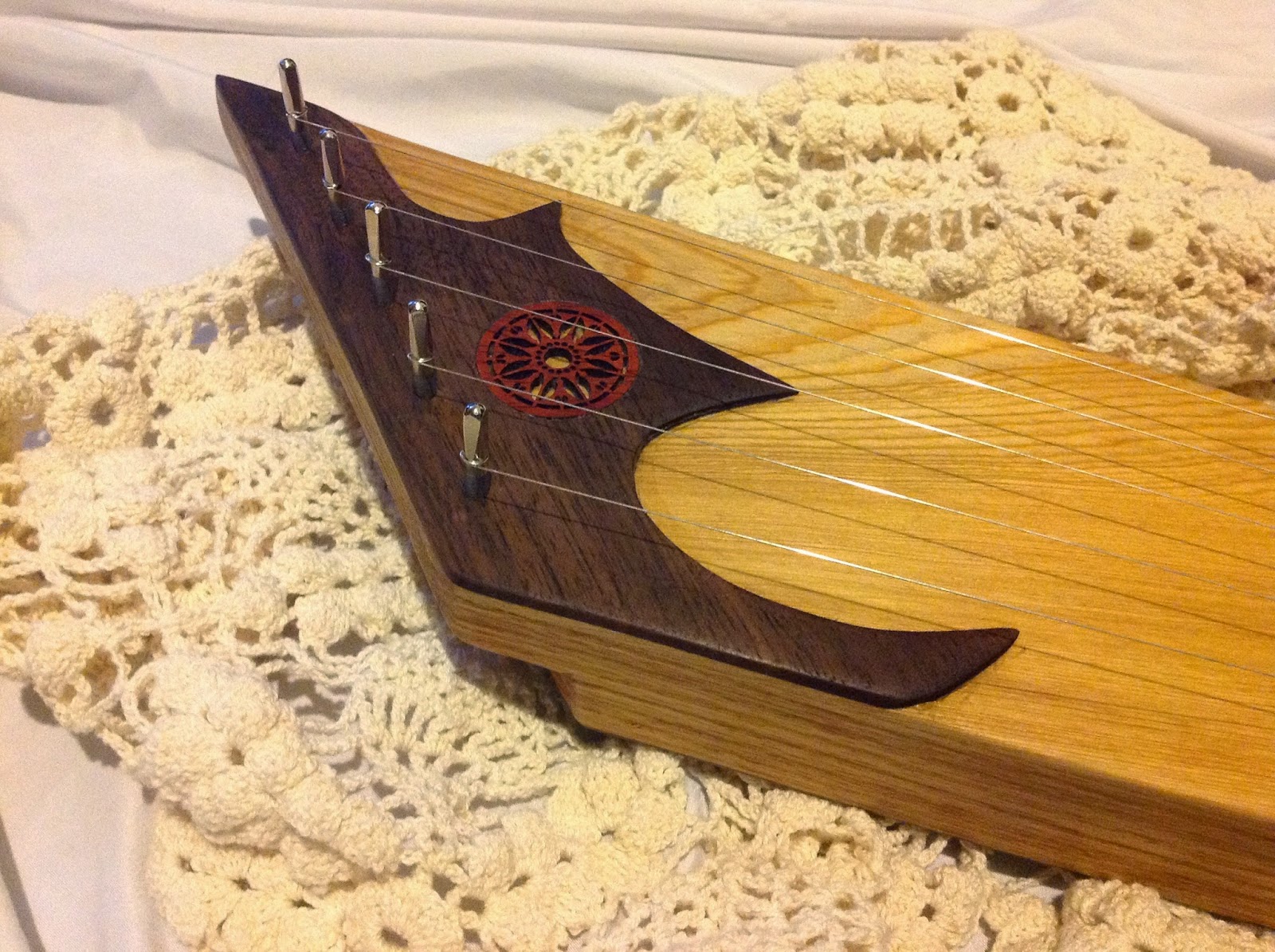 This kantele was my first kantele, the beginning steps into my journey into not only the world of the kantele, but better instrument making in general. I finished this one in January, and am quite pleased with the results. You can click on the thumbnail photos for larger detailed pictures. This kantele uses red oak sides and tuning peg shelf, which was leftover wood I had bought from The Home Depot for another project. The front part under the ponsi is a bit of leftover mahogany from wood I had used for a traditional bow many years ago. The ponsi and decorative headplate consist of black walnut, with a thin stripe of padauk at the bottom of the ponsi, and a very nice little padauk rosette which I bought from Folkcraft Instruments, inlaid into the headplate. The backboard also consists of black walnut with a single 1.5" diameter sound hole.
 The soundboard took me a while to decide upon. Often times, woods like poplar are used. Its a relatively soft wood, and good choice for soundboards, but I wanted something with more grain character. Pine is ok, but still a bit lower quality and dull for what I was intending. Spruce, particularly sitka spruce, is often hailed as one of the best quality soundboard materials for stringed instruments. It is a bit harder to find smaller pieces for kantele however, and still has a bit boring (in my opinion, compared to other woods out there) grain pattern. Its also used on many, many guitars, and I wanted something a bit different and less common. After doing some searches and comparisons, I found that cypress has a very nice grain look, and has very good soundboard characteristics. From the Wood Database, here are some general stats on the wood:
 I made this kantele as a 5 string instrument, 24" long, and a little wider at 5". I wanted to experiment with a wider model 5 string instrument and play around with wider string spacing than normal.
 The kantele is a very unique instrument. Simple, elegant, and relatively easy to learn and improvise on - often times I liken it to the "Native American flute" of the stringed instrument world. This little known instrument hails from Finland, with a history and tradition wrapped in the roots of legend and folklore. It was said, in the great Finnish epic The Kalevala, that old Vainamoinen, powerful, ancient, and magical bard and minstrel, created this instrument, first from the jawbone of a pike strung with the mythic hairs of a stallion, and later from a birch tree (birch being the national tree of Finland and given great significance in the Kalevala) strung with the hairs of a maiden.

