Showing posts with label instrument. Show all posts

Sunday, February 1, 2015

Pseudo-Build Log of Kantele #001

When I first started making my kantele, I had intended on creating a detailed build log with all the steps. However, I got too caught up in making the kantele and as a result, got rather lazy on documenting my progress. Though this isn't a true build log, It does give a kind of general flow of how this kantele was built. I didn't include all of the details such as the backboard, decorative headplate, or ponsi, but this gives the rough basics of building the frame as a general reference. You can click on the thumbnails for a larger picture. To see the completed kantele just click on the first link below at the bottom of the page.


Extra Sources and Info:

1.) Kantele #001 Info:  http://oertheeternalstrings.blogspot.com/2014/10/kantele-001.html


Saturday, January 31, 2015

Some Future Kantele Wood Choices

Having designed, built, and played kantele for a little over a year now, I have given a great deal of thought for new kantele, future woods, accents, and combinations. Part of the fun of building them yourself is being able to customize every aspect of the instrument, adding woods and features that would otherwise cost a small fortune if custom built by a professional luthier. And if you know where to look, you can get some exquisite woods for very, very cheap. Here are some examples of the nicer sets of wood I have been saving for future kantele builds that I hope to be starting very soon. Originally I bought these woods many years ago for making Native American flutes, but it never panned out past the trial ones and have been just sitting around all these years. But they are perfect for kantele sides.

kantele frame woods from left to right - cocobolo, bocote, curly claro walnut, east indian rosewood
Kantele woods left to right: cocobolo, bocote, curly claro walnut, east indian rosewood

The first on the left is set of cocobolo, each piece 24"x1.5"x.75". Cocobolo is one of the most famous and beautiful of the rosewoods, and is lined up for my next build of kantele #005. As soon as I sat down to think of the wood combinations I almost immediately knew what accents I wanted with it: very thin veneers of cherry with thicker stripes of purpeheart on the sides, with a cherry and purpleheart decorative headplate and carved ponsi, and a purpleheart backboard. I have worked with purpleheart recently, and it has turned out to be a very beautiful wood, one of my favorites now. For the soundboard I want to try something different and unique, and have decided to pair this kantele with an aromatic cedar soundboard. It should make a truly fine 5 string kantele, one I look forward to completing and using.

The second set, reserved for kantele #006, and my personal favorite of all the sets I have, is an exquisite book-matched pair of bocote wood, one of my absolute favorite woods. It is characterized with a very striking swirling grain of blackish-brown stripes on a golden yellow background. I have been saving this set for quite some time, and am looking to make this my most exquisite 5 string kantele. I will also be saving up to use much more exotic and expensive woods for this one, and haven't quite decided on the combination yet. I do know I would like to use exotic burls for the ponsi and decorative headplate, but I haven't quite got a good combination for side stripes and backboard yet. As for the soundboard, I will most likely try to go with something along the lines of a heavily curly redwood soundboard, possibly look at sources of ukulele or guitar soundboard suppliers. I also plan on attempting some more ornate carving and adding extra details using horn/bone, mother of pearl, and possibly crushed stone. I aim to make this my own personal kantele and as a template for what I would like to consider as "master-class" kantele.

The third set for kantele #007 is a very nice set of custom cut curly claro walnut. These pieces are longer, and I aim to use them for either an 11, 12, or 15 string kantele. I will probably make this one an open backed kantele. I will definitely be using bloodwood for the side accents and decorative headplate, and for the ponsi will be using a stunning block of curly paradox walnut, which has to be one of the nicest blocks of wood I have had in my collection yet. The soundboard will also use a beautifully custom cut piece of butternut. Butternut, especially of larger sizes, has become increasingly difficult to find, and took me a while to source a place for it. It took me a great deal of thought and comparison of soundboard woods to decide on the pairing for this kantele. Butternut is an excellent soundboard material, with a warm and rich tone like walnut (also known as "white walnut", which is one of the reasons for choosing it for this kantele, as a contrast to the darker walnut woods used). It has the benefit of being much softer than walnut though, making it more responsive as a topwood while still retaining a walnut-like quality. It is also known for its beautiful cream color and grain, extra bonuses for a topwood.

curly paradox walnut for carved ponsi for kantele
An exceptional block of curly paradox walnut

And finally, for kantele #008, is a beautiful set of east indian rosewood. This kantele will also use the curly paradox walnut block for the carved ponsi and a butternut soundboard like #007 as described above. This too will be a large kantele, most likely a 15 string possibly with drone strings. It will use zebrawood accents, as well as zebrawood for the decorative headplate.

In my next post I will share the sources where I get these woods, some of which being my absolute favorite places to order exotic woods for not only kantele projects, but other woodworking projects as well. Excellent selections, excellent prices, excellent services and shipping - these places are the places to go for some high end wood on a budget!

Monday, January 26, 2015

Kantele #004

kantele #004 handmade 5-string exotic hardwoodIt has been quite a while since I have last posted about my kantele builds and endeavors. I finished kantele #004 last year towards the end of last summer, but instrument building has been on hiatus due to switching gears for crafting numerous birthday and Christmas presents for the past several months from September to December, and has been a very busy schedule. This newest kantele I must say though is my absolute favorite one to date, and was definitely a challenging but rewarding build.

kantele #004 bubinga tuning peg shelf and frame and tuning pinskantele #004 handmade carved wenge decorative headplate and tuning pinsKantele #004 features probably the most exotic wood selection of my kanteles yet. The frame is made from bubinga, an extremely heavy and hard wood with excellent tonal qualities. The sides also feature a soft maple strip at the bottom for a bit of contrast. The backboard and headplate are made from wenge, another very hard and dense wood. It can be a bit tough to work with due to its hardness, but can carve quite nicely if done slowly and carefully, and takes an excellent polish. The soundboard is the same as the first three kantele, using 1/8" cypress. This piece of cypress was the most uniform and straightest grain of all the pieces I got, and specifically saved it for this instrument.

I am quite proud of the ponsi for this particular kantele. It is made from wenge with a thin strip of padauk at the bottom. The theme is definitely different from my previous kantele, with sharp, carved ridges and a center ridge protrusion in the arc where the varras is located. This ponsi was shaped entirely through file-work, and was very fun to design and work on.
kantele #004 handmade dragon flair style carved wenge and padauk ponsi

If you also notice the back, there are four 1.5" sound holes instead of the normal one soundhole for most kantele. For this instrument I still wanted a backboard to help increase resonance, as well as liking the overall aesthetics of a backboard, but due to its narrow size and overall smaller vibrating area on the soundboard the volume might suffer. The extra holes allow for more volume while still retaining the qualities and aesthetics of a backboard, with a unique twist.

kantele #004 wenge backboard with four soundholes
The overall theme of the kantele is more simple than my previous ones, but more elegant, with a juxtaposition of curves to sharp corners and ridges. The dark wenge stands out in beautiful contrast with the lighter woods, with the grain and figure really showing on the backboard. This instrument is also HEAVY. Its the smallest overall size of all my kantele, but by far the heaviest and densest due to the thick bubinga frame. I had designed it this way as I prefer heavy instruments, and wanted to explore the tonal qualities of using extremely heavy and dense woods for the frame. And I think I definitely achieved my goal. Tonally, it is my favorite of my kantele. The heavy dense woods really allow the overtones and harmonics to blend and ring inside the instrument, and has a rich, bright, and complex tone with exceptional resonance. You can actually hear a soundclip of this instrument at the top of The Kantele - Strings of Magic and Lore post.

Extra Sources and Info:

1.) Kantele #001 Info:  http://oertheeternalstrings.blogspot.com/2014/10/kantele-001.html

2.) Kantele #002 Info: http://oertheeternalstrings.blogspot.com/2014/11/kantele-002.html

3.) Kantele #003 Info: http://oertheeternalstrings.blogspot.com/2014/11/kantele-003.html

Thursday, November 6, 2014

Kantele #001

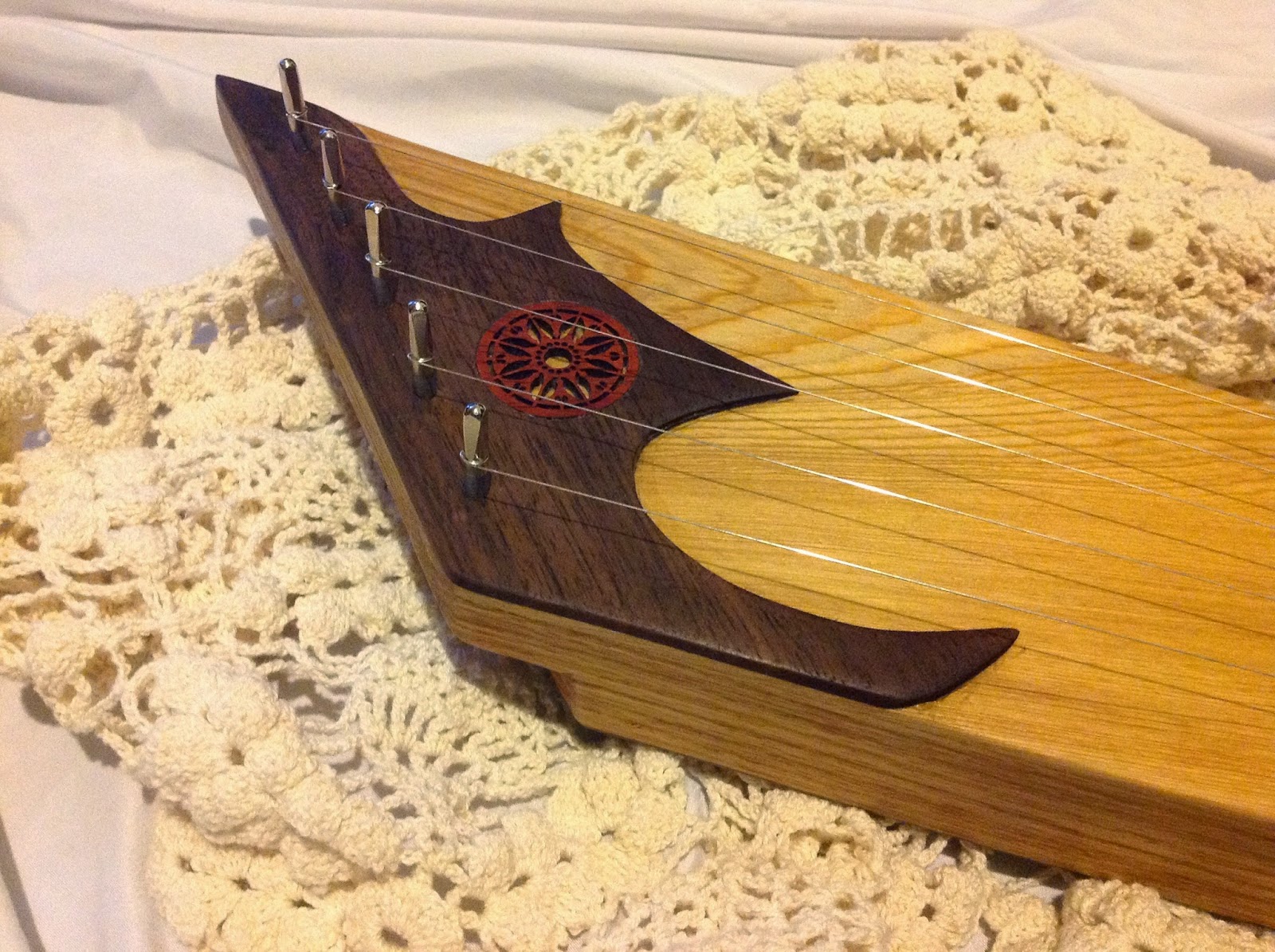
completed 5 string kantele #001
kantele #001 decorative headplate with rosette inlay and tuning pinsThis kantele was my first kantele, the beginning steps into my journey into not only the world of the kantele, but better instrument making in general. I finished this one in January, and am quite pleased with the results. You can click on the thumbnail photos for larger detailed pictures. This kantele uses red oak sides and tuning peg shelf, which was leftover wood I had bought from The Home Depot for another project. The front part under the ponsi is a bit of leftover mahogany from wood I had used for a traditional bow many years ago. The ponsi and decorative headplate consist of black walnut, with a thin stripe of padauk at the bottom of the ponsi, and a very nice little padauk rosette which I bought from Folkcraft Instruments, inlaid into the headplate. The backboard also consists of black walnut with a single 1.5" diameter sound hole.
 

kantele #001 black walnut backboard with soundholeThe soundboard took me a while to decide upon. Often times, woods like poplar are used. Its a relatively soft wood, and good choice for soundboards, but I wanted something with more grain character. Pine is ok, but still a bit lower quality and dull for what I was intending. Spruce, particularly sitka spruce, is often hailed as one of the best quality soundboard materials for stringed instruments. It is a bit harder to find smaller pieces for kantele however, and still has a bit boring (in my opinion, compared to other woods out there) grain pattern. Its also used on many, many guitars, and I wanted something a bit different and less common. After doing some searches and comparisons, I found that cypress has a very nice grain look, and has very good soundboard characteristics. From the Wood Database, here are some general stats on the wood: 
  • Janka Hardness: 510lbf
  • Average Dried Weight: 32lbs/ft^2
  • Specific Gravity: 0.42
  • Elastic Modulus: 1,440,000 lbf/in2 (9.93 GPa)
Overall, very similar characteristics to the commonly used spruces, with the bonus of more interesting grain. I ended up using 1/8" thick soundboard wood (as well as 1/8" backboard), which is a very good thickness to start with for smaller kantele. For reference, I strongly recommend The Wood Database as an excellent resource for basic wood properties and information, especially for when comparing specific statistics of different woods. They have an extensive and excellent list of many domestic and exotic wood species. For soundboards, backboards, and woods for the ponsi and decorative headplate, I often buy woods from D&D Hardwoods. The selection, products, prices, and service is top-notch, and I have ordered from them many times for all of my kantele so far, and greatly recommend them for thin woods for smaller sized kantele. I will write a more detailed and full review in coming posts, but they are definitely one of my favorite wood sources yet.


kantele #001 black walnut and padauk carved ponsi front view
kantele #001 dragon flair style carved ponsi viewI made this kantele as a 5 string instrument, 24" long, and a little wider at 5". I wanted to experiment with a wider model 5 string instrument and play around with wider string spacing than normal.
With my kanteles, I also want to create a unique and distinct style of my own. This design came about from a combination of both a lack of tools at the time, and a want to explore new styles, which has stuck with each kantele so far. One major difference with my kanteles is the shape: the front is pointed as opposed to the traditional round ponsi end. I did this for ease of construction, which also happened to fit well with my kantele themes. Another unique feature is the carved ponsi. Each kantele has its own theme, represented by the decorative headplate at the tuning peg end, and the ponsi. I have added what I like to call "dragon flairs" on the ponsi, giving them more distinct flavor as opposed to the more traditional simple straight or slightly rounded ends on the ponsi. My kantele are also heavier than normal, using thicker woods for the frame. I have always preferred the feel of a heavier instrument, and as this thickness is most commonly available (3/4" thick), I have decided to stick with it.


Most kanteles I have seen use relatively simple woods, such as birch, pine, poplar, mahogany, and walnut. These are great and relatively inexpensive woods to start with, with woods like birch having cultural significance in the folk roots of traditional kantele making. I wanted to expand and use more exotic choices, adding things like contrasting strips on the sides, and unique carved themes and accents. My later kanteles reflect this, with more exotic choices with each one I make. Stay tuned for sound clips and a playing description of this kantele in upcoming posts!

Extra Sources and Info:

1.) The Wood Database: http://www.wood-database.com/

2.) Folkcraft Instruments: http://www.folkcraft.com/search.html?sep=rosette&sed=128

3.) D&D Hardwoods: http://www.dndhardwoodsonline.com/

Monday, September 29, 2014

The First Strings Are Strung

It took a very long time (many more months than it should have), but here I am, my first steps into the world of blogging. Though my general indecisiveness (particularly with naming the blog) has been the main inhibiting factor, I am eager to start down this path to further explore and share some of my work and passions with the outside world.

It is my hope to provide readers with insightful knowledge and information across a broad range of topics concerning the kantele (for those of you who are not familiar, the kantele is a traditional stringed zither from Finland, and there will be plenty more on this subject to come), world instruments, instrument making, woodworking, crafting, and music, gathered from my continuing journey exploring these different, yet related paths. In time I will not only include information on instruments I have built, but tutorials, guides, resources, DIY info, suggestions and thoughts, instrument building on a tight budget, sheet music, compositions, and audio and video of the various kantele and other instruments I have made and will be making. I also strongly encourage asking questions, leaving comments, and engaging in discussion about the various topics or related content presented, and am very eager and more than willing to answer any questions and give help or suggestions related to these subjects to the best of my ability.

I am not a musician. Or a professional woodworker. Or a luthier. I am (however unrelated to these fields, though having some interesting cross-applications) simply, and quite happily, an electrical engineer who happens to have these interests and hobbies that have grown and developed from a long history and fascination with world instruments. These two passions of mine, engineering and instruments/crafting/woodworking, have often and always clashed for my attention (and spare project money), but have given me a chance to explore many interesting topics over the years.

The first strings are strung, the first notes have been plucked, and the melody begins to unfold. I invite you to explore this symphony with me.